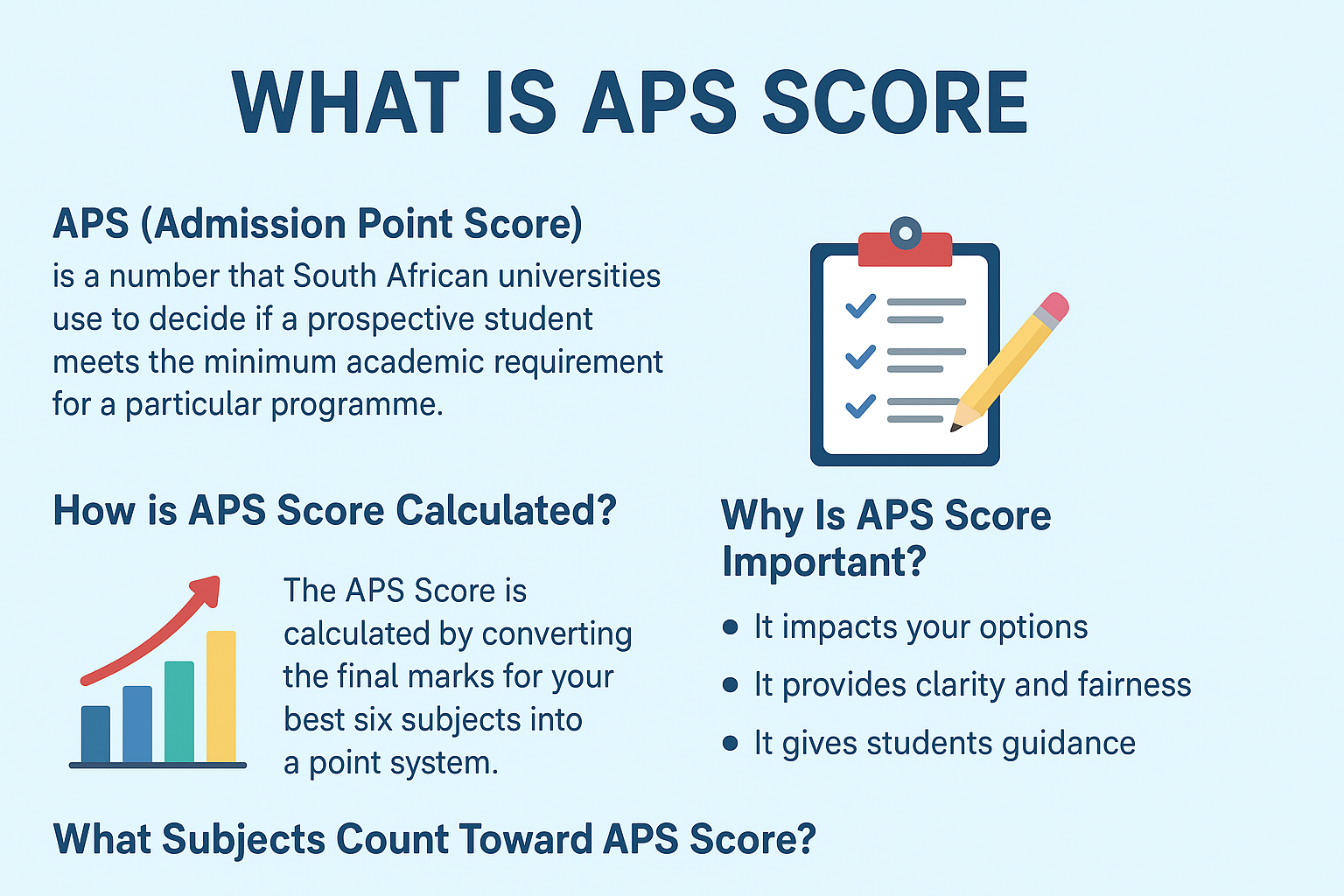
The term APS Score, short for Admission Point Score, plays a key role in South Africa’s university admission system. If you’re completing matric or preparing to apply for higher education, understanding your APS is essential.
In simple terms, your APS score turns your final school results into one clear number. This number shows universities how well you performed across subjects and whether you meet the minimum entry requirements for a specific course.
Getting a good APS score doesn’t automatically guarantee admission, but it greatly improves your chances. It helps you see where you stand, compare universities, and plan realistic goals for your studies.
In this guide, we’ll unpack everything — what an APS score is, how to calculate it, what subjects count, why it matters, and how you can improve yours.
What Is APS Score
The Admission Point Score (APS) is a numerical value that South African universities use to determine if you qualify for a certain degree, diploma, or certificate. It’s a fair and standardized way to evaluate students from different schools and backgrounds.
Key points to remember:
- The APS converts your matric subject marks into a single score.
- Each subject is worth a specific number of points based on your final percentage.
- Universities usually use your best six subjects to calculate your APS.
- The higher your APS, the greater your chances of being accepted into competitive courses.
The APS makes it easier for institutions to assess thousands of applicants quickly and fairly. It ensures that everyone is judged using the same academic scale, no matter which school they attended.
How Do You Calculate Your APS Score
Calculating your APS is simple once you understand the steps. It’s based on the percentage you earned in each subject during your matric year.
Step-by-step process:
- Identify your subjects – Choose the six subjects that will count towards your APS. Life Orientation usually does not count.
- Convert your marks into points using the standard APS scale below: Percentage APS Points 80–100% 7 70–79% 6 60–69% 5 50–59% 4 40–49% 3 30–39% 2 0–29% 1 or 0 (depending on the institution)
- Add up the points for your six subjects to get your total APS score.
- Compare your total to the minimum APS requirement for your chosen course.
Example Calculation
Let’s say you got these final marks:
- English: 78% → 6 points
- Mathematics: 82% → 7 points
- Life Sciences: 63% → 5 points
- Physical Science: 71% → 6 points
- Geography: 58% → 4 points
- Business Studies: 74% → 6 points
Your APS = 6 + 7 + 5 + 6 + 4 + 6 = 34
That means your total APS is 34 points. You can now compare this score with the university’s entry requirements for your desired course.
To calculate your APS score online, use our aps score calculator
Why Is the APS Score Important
It determines your eligibility
Your APS is the first thing universities look at when processing your application. If you don’t meet the minimum requirement, your application may not even be considered.
It creates fairness
Different schools have different grading systems and subject choices. The APS evens the playing field, providing a consistent way to measure performance across the country.
It guides your planning
Knowing your APS early helps you make informed decisions about which universities and programmes to apply for. It helps you identify where you might need to improve before submitting applications.
It influences scholarships and bursaries
A higher APS score doesn’t just open doors to better programmes — it can also improve your chances of receiving financial aid or academic bursaries.
What Is a Good APS Score
There’s no single “good” APS score — it depends on the programme you want to study. Each university sets its own requirements. However, here’s a general guideline:
- Bachelor’s Degree: Minimum APS of 23 or higher
- Diploma Programme: Minimum APS of 19 or higher
- Higher Certificate: Minimum APS of around 15 or higher
Keep in mind that some highly competitive degrees, like medicine, law, and engineering, may require APS scores well above the minimum — often 35 or more.
What Subjects Count Toward the APS Score
Typically, the following subjects are considered:
- Home Language
- First Additional Language
- Mathematics or Mathematical Literacy
- Three Elective Subjects
Life Orientation usually does not count toward your APS. However, always check your university’s specific policy — some may include it for certain programmes.
Choosing the right subjects matters
- If you’re aiming for a science or engineering degree, you’ll need Physical Science and Mathematics.
- For business or commerce programmes, strong results in Maths and Accounting can boost your score.
- For arts or humanities, language and social science subjects usually carry more weight.
Selecting subjects that align with your strengths — and your future goals — is the best strategy for achieving a higher APS.
Common Questions About APS
How many subjects are used to calculate APS?
Most universities use your best six subjects, excluding Life Orientation.
Can I improve my APS score after matric?
Yes. You can rewrite one or more subjects to achieve better marks. Improving even one grade level (for example, from 60% to 70%) can add an extra point to your total.
What if my APS is too low?
If your APS doesn’t meet the minimum requirement:
- Apply for a diploma or higher certificate programme as a stepping stone.
- Consider rewriting one or two subjects to raise your points.
- Explore bridging programmes that prepare you for university-level study.
Does every university use the same APS system?
No. The APS system is widely used, but each university can have small differences in how they calculate or apply it. Some may include extra assessments, interviews, or entrance tests. Always confirm the rules for your chosen institution.
How to Improve Your APS Score
Improving your APS score takes focus, discipline, and smart study habits. Here are some proven strategies:
1. Strengthen your core subjects
Your languages and mathematics carry significant weight. Invest time in understanding these subjects deeply rather than memorizing content.
2. Choose subjects you enjoy
Students perform better when they’re genuinely interested in what they study. If you enjoy a subject, you’re more likely to put in extra effort — which leads to higher marks.
3. Aim for small improvements
Each level of improvement in your grade bracket adds valuable points. Moving from 69% to 70% can make the difference between a 5 and a 6 on the APS scale.
4. Use your time wisely
Plan your study schedule early in the year. Avoid cramming. Consistent practice and revision lead to better understanding and higher marks.
5. Ask for help early
Don’t wait until exams to seek help. If you’re struggling in a subject, get tutoring or extra lessons early on.
6. Take advantage of rewrite opportunities
If you’re unhappy with your results, you can rewrite certain subjects to increase your marks and raise your APS.
7. Stay motivated
Remember, your APS score is not a reflection of your intelligence — it’s a reflection of your preparation and effort. With consistent work, anyone can improve.
Understanding APS in University Admissions
How universities use the APS
When universities receive applications, they often shortlist candidates based on APS before considering other factors like motivation letters or additional tests.
Some competitive programmes, such as law, health sciences, or architecture, have high cut-offs due to limited spaces. That’s why knowing your APS early helps you plan your options more strategically.
Beyond the APS
While APS is critical, universities may also look at:
- Specific subject requirements (e.g., Maths for Engineering)
- Entrance exams or interviews
- Portfolios for creative courses
- Additional criteria such as volunteering or leadership activities
So, a strong APS is your foundation — but it’s only one part of a well-rounded application.
What to Do If Your APS Is Below the Requirement
Don’t panic if your score is lower than expected. There are several ways to move forward:
- Rewrite subjects to raise your marks.
- Apply for a diploma or higher certificate, then upgrade to a degree later.
- Look into bridging programmes designed for students just below the minimum APS.
- Consider private colleges with flexible entry requirements.
- Gain experience or training in a related field, then return to studies later.
Every path can lead to your goal — it just might take a different route.
Final Thoughts
Your APS score is a key that can unlock or limit your study options after matric. It summarizes your academic performance in a way universities can quickly understand and compare.
Knowing how your APS is calculated gives you the power to plan ahead. You can track your progress, identify weak spots, and take practical steps to improve before it’s too late.
Remember: your APS is not the end of your story — it’s just a starting point. Whether you meet your first-choice programme’s requirements or have to take an alternative path, your determination and effort will shape your success far more than any single number.